
Elements of Design
The Golden Mean - Proportion /8


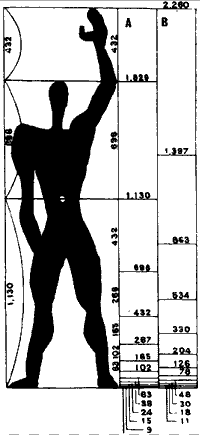
Le Corbusier devised a system of proportions
and measurements which he called the Modulor. This consists of two sets
of figures. The first is based on the height of the average man (I.829
metres, or 1829 millimetres). If this height is divided according to the
Golden Section (see right ), the longer of the two parts will be 1130
millimetres. This also corresponds to the navel height, as we have already
seen in diagram on page7. This height can again
be divided according to  the
the
Golden Section, when the figure 698 millimetres
will be obtained for the longer part. We can go on dividing and subdividing
according to , until a whole range of figures is found. This is column
A in diagram on right. Column B is obtained in the same way, but in this
case the starting point is the height of the average man with his arm
stretched up. This dimension is divided again and again as in the case
of column A.
Each column is a Fibonacci series, that is to say each figure is the sum
of the two preceding it.
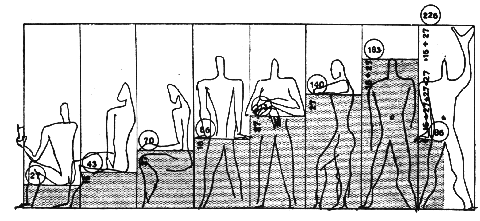
The Golden Section, which is felt by most people to be the most natural and pleasant way of dividing a line or constructing a rectangle, and for which we have also found a mathematical basis, is used again and again in the Modulor to provide two series of measurements which are harmoniously related to each other. As diagram 3 shows, they are also related to important points of the human frame. Furniture designed to these measurements, can therefore be both harmonious and practical at the same time.
by Kurt Rowland ©1965 (out of publication)